

I Thought I Was Giving My Dog the Best Life. Then I Checked Our Indoor Air.
I never thought about the air in my house until my vet said something that stopped me cold. “The number one thing most cat owners overlook,” she told me, “is what their pets are breathing every single day.”
The Conversation That Changed Everything

Charlie had been sneezing more than usual. Not dramatic — just a small, recurring sneeze I’d been writing off as dust or dry air. The vet said he was in good health for his age.
But then she asked something I hadn’t considered.
“What’s your indoor air quality like?”
I had no answer. I’d spent two years researching the best cat food, enrichment toys, sleeping setups. I’d never once thought about what Charlie was actually breathing 24 hours a day.
“Cats have much smaller, more sensitive respiratory systems than humans,” she explained. “They process a higher volume of air relative to their body weight, and they spend almost their entire lives indoors. Whatever is in that air, they’re getting significantly more of it than you are.”

What's Actually Floating in Your Home Right Now
Most people are surprised to learn that indoor air is consistently 2 to 5 times more polluted than outdoor air, according to the U.S. Environmental Protection Agency. In homes with pets, the situation is more complex.
|
The invisible threats in a pet home: • Pet dander — microscopic skin flakes that trigger respiratory inflammation • Dried saliva proteins — become airborne when pets groom, land on every surface • Bacteria & viruses — shed from skin, litter boxes, food bowls, and bedding • Mold spores — concentrated in humid corners and litter areas • Fine dust & particulate matter — constantly resuspended by your pet’s movement |
Cats and dogs can’t tell you when their throat feels irritated or their breathing feels labored. They just live with it. Over months and years, chronic low-level respiratory irritation contributes to conditions that shorten their lives — and dramatically increases veterinary costs.
Why Pet Respiratory Systems Are More Vulnerable Than Yours
A cat at rest takes 20 to 30 breaths per minute. A dog takes 15 to 25. A resting adult human takes 12 to 16. Your pets are processing significantly more air — and more of whatever is suspended in it — simply by existing in your home.

The conditions that develop silently — chronic rhinitis, feline asthma, bronchitis, recurrent respiratory infections — are among the leading non-accidental causes of shortened lifespan in indoor cats and dogs.
What Negative Ions Do That Filters Can't
Standard filters pull air through a mesh — they only clean air that happens to pass through the machine. Particles near your pet’s bed, near the litter area, in the corner of the room never reach the filter.
Negative ion technology works differently. Hospitals have used ionized air systems in operating theatres and critical care for decades [2]— because ions neutralize airborne pathogens throughout the entire space, not just near a single machine.
|
How negative ions protect your pet’s air: • Negative ions flood the room continuously with electrically charged molecules • They bond to positively charged particles — bacteria, mold spores, dander, viruses • Bonded particles become too heavy to remain airborne • They fall out of the breathing zone and settle — where they can be wiped away • Studies show up to 90% reduction in airborne bacterial counts in enclosed spaces[1] |
For a small animal with a sensitive respiratory system spending every night in a sealed bedroom, the difference between air with high bacterial load and air with dramatically reduced pathogen concentration is not trivial. It accumulates — breath by breath, night by night, year by year.
The Device I Plugged In Next to Charlie’s Sleeping Spot
I didn’t want a $400 purifier I’d have to maintain and replace filters on every few months. I wanted something that just ran — without me thinking about it.
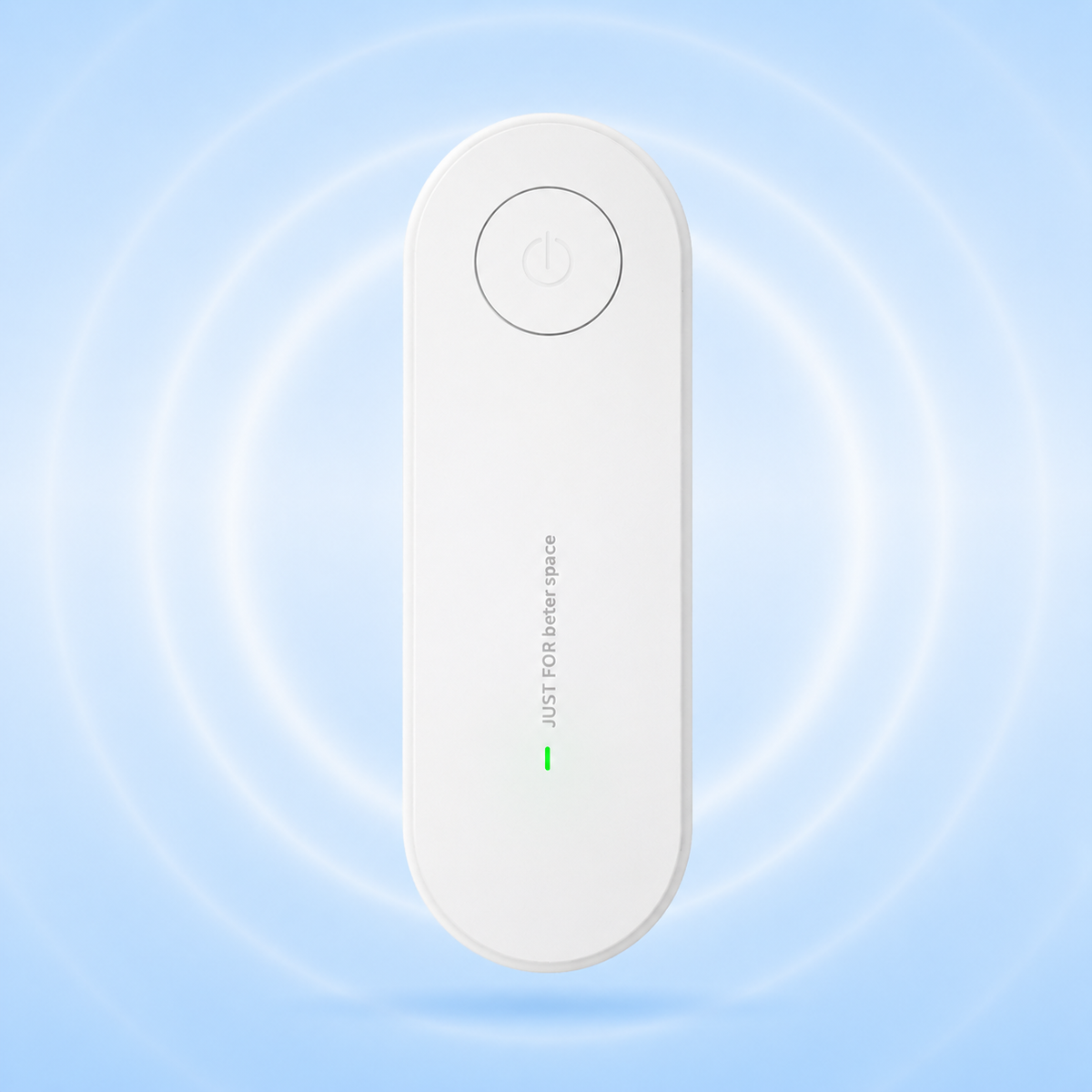
The Domkaka™ plugs into any standard wall outlet. It’s about the size of a large USB adapter. It draws almost no power. And it runs completely silently — which matters, because Charlie is a light sleeper and anything with a fan wakes him immediately.
I put one next to his sleeping spot on the bedroom floor. One near his food and water station. I ordered a third for the living room where he spends most of his afternoons.
|
Domkaka™ — what matters for pet owners specifically: ✓ Releases up to 8 million negative ions per cm³ — continuously, 24 hours a day ✓ No ozone produced — completely safe for cats, dogs, birds, and small animals ✓ Completely silent — no fan, no hum, zero disruption to sensitive animals ✓ No filters, no refills, no ongoing cost — plug in once, it runs forever ✓ Works on standard US/UK/EU outlets — no adapter needed ✓ Small enough to place anywhere — pet beds, litter areas, food stations |
What Happened — And What the Next Vet Visit Showed
Charlie’s sneezing stopped within about a week. I told myself I was imagining the connection. I kept the device running anyway.
Three months later, at his regular checkup, his vet noted his nasal passage looked less inflamed than at the previous visit. She asked if anything had changed in our home environment.
I told her about the Domkaka™.
Research published in peer-reviewed journals supports the use
of negative ionization for airborne pathogen reduction.
[3]
|
My two cats have both seemed more settled and less sneezy since I started running these. Can’t say for certain it’s the ionizer but the timing lines up and I’m not taking it out. — Verified Domkaka™ Customer, Cat Owner ★★★★★ |
|
My dog Biscuit has always had mild environmental allergies. Since running the Domkaka in the bedroom where he sleeps, his itching and eye watering has noticeably reduced. His vet mentioned his airway inflammation looked better at his last checkup too. — Verified Domkaka™ Customer, Dog Owner ★★★★★ |

The Math That Made Me Order Three More
Domkaka™ costs $29. A single veterinary respiratory consultation typically costs $200 to $600. Ongoing medication for chronic feline asthma runs $40 to $120 per month.
I’m not making a medical claim. I’m making a simple observation: anything that meaningfully reduces airborne bacterial and particulate load in the space your pet breathes continuously is worth $29 — especially when it requires zero maintenance and lasts indefinitely.
|
The honest cost comparison: Domkaka™ one-time cost: $29 Standard HEPA filter replacements: $40–$80 per year Single vet respiratory consultation: $200–$600 Monthly chronic respiratory meds: $40–$120 per month Domkaka™ ongoing cost: $0 — no filters, no refills, ever |
You’ve already done everything you can think of. The best food. The vet checkups. The toys and warmth and years of companionship.
This is one more thing. Small. Silent. Effortless. Running in the background every night while your cat curls up next to the outlet, and your dog settles into his spot on the floor.
You can’t add years to their life with certainty. But you can remove one of the quiet, invisible things that might be shortening it.


U.S. Environmental Protection Agency. "Indoor Air Quality —
Introduction to Indoor Air." 2023.
https://www.epa.gov/indoor-air-quality-iaq
Grinshpun, S.A. et al. "Performance of portable air purifiers
and negative ionizers in reducing airborne microbial
concentrations." American Journal of Infection Control.
https://pubmed.ncbi.nlm.nih.gov/15926144/
American Academy of Allergy, Asthma & Immunology.
"Pet Allergy Overview." 2023.
https://www.aaaai.org/tools-for-the-public/conditions-library/allergies/pet-allergy